Gertrude Stein Concentrate and Try Again
Gertrude Stein'south subjects, objects, and the illegible
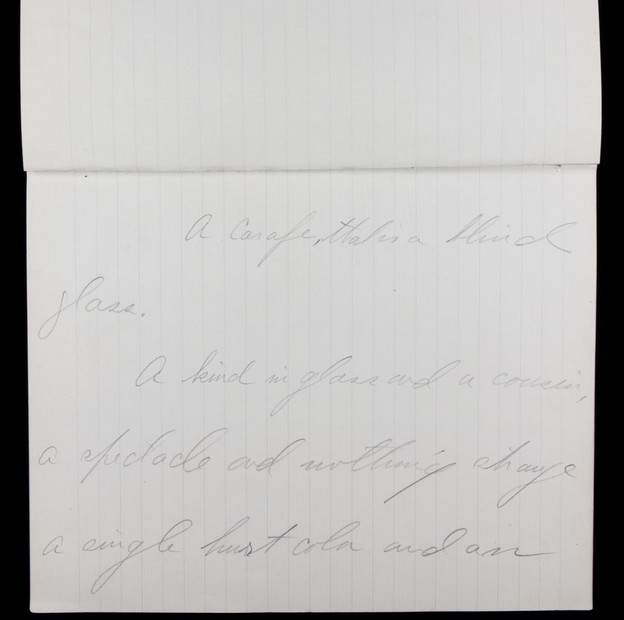
In the summer of 1912, while vacationing in Kingdom of spain, Gertrude Stein began to write short prose poems on discrete objects and little events (shopping, eating, talking) that comprised ordinary daily living. Generating poems from such mundane experience was not on its ain anything too radical, but Stein paired such ordinary objects and experiences with an boggling new grammar.
Stein had earlier experimented in The Making of Americans with conveying normal life with non-normative poetics, but in this new writing the banal objects appeared to disintegrate or discombobulate while the grammer was carve up apart at the seams. Stein collected this work and published it as Tender Buttons in 1914, and from its showtime appearance upwardly to today, no one has settled how this book should be read. What kind of book is it that people however read it later on one hundred years and all the same still question the meaning of the book and how to read information technology?
Tender Buttons is enigmatic on its own, merely to add to its legend, few readers know that the manuscript was untitled until the final few weeks before publication, that Stein about did not have the book reach publication at all, and that she would non publish another book until eight years later. A brief history of the publication of Tender Buttons tin can provide insight into Stein's focus on composition, and offer some new directions for reading it.
Stein was first contacted by Claire Marie Editions to publish a recent work of hers on 18 Feb 1914. The letter opened with an offer: "I should very much like to publish in book form the plays of yours that Mrs. [Mabel] Dodge has told me about. Will y'all allow me do information technology?"[1] Stein might have indeed published her plays before Tender Buttons, thus becoming first publicly known as an avant-garde playwright rather than as a poet, only friends persuaded her that the plays should be performed before being printed. Claire Marie's alphabetic character came on business letterhead and appeared to Stein to be an up-and-coming printing of some import. "My public is also the nigh civilized in this country," the publisher boasted.
This was a bluff, and the publisher had no public notoriety; in fact, it was a vanity printing run by Donald Evans, a New York–based literary hopeful and socialite. The printing was named after the little-known actress Claire Marie Shush, who had no relation to the publishing venture. Evans had published simply a few friends and his own melodramatic and not very modern poetry upwards to that bespeak. Stein was under the impression during the whole publication process that she was corresponding with a adult female. Recalling the letters in The Autobiography of Alice B. Toklas, Stein writes, "Nosotros took it for granted that there was a Claire Marie just evidently there was not."[2]
Evans had befriended Carl Van Vechten in New York City, who suggested to Evans that he publish something by Stein, perhaps her first plays. Upon Evans's first inquiry, Stein instead sent a work in iii sections, very similar in tri-part structure to her only other published book, Three Lives (in the Autobiography, Stein credits Evans for the thought to publish "three manuscripts to brand a small-scale book" [Writings, 814]). The three works Stein sent were published past Evans, beginning with "Objects," then "Nutrient" and "Rooms" — and the society has never changed since, even though there is plenty archival prove that "Objects" was most certainly the last section written and never intended past Stein to be the commencement in order. In the bound volumes that Toklas afterwards typed up to record Stein's piece of work in the issue that it was lost, she begins with "Rooms." In Stein'due south cahier manuscript notebook, "Food" carries the subtitle "Studies in Clarification" and is the but department for which Stein compiled a table of contents (included in the published edition), suggesting an earlier intention to list the titles of the prose poems up front. All evidence points to Evans as the i who put "Objects" first, and Stein did not complain or demand any different ordering of the sections in any future reprint. For a writer who stressed exactitude and faithful reproduction of her work, this rather meaning editorial contribution made an impact that Stein might not have foreseen, as it turned "Objects" into the center of attention and effectively fabricated the other sections into secondary works.
Stein received a letter dated 18 March 1914, notifying her of the intent to publish her book along with a book contract containing fiscal details. This was to be the outset book Stein would publish that she did not pay for herself, and it was too the start fourth dimension Stein had an opportunity to participate in any item in book design. By Stein's choice, the volume had footling in the way of design at all. In the March letter of the alphabet, Evans writes, "There will be no illustrations or tail or caput piece or introduction or dedication, every bit y'all inquire" (YCAL). Tender Buttons is very visual, the poems full of colors and synesthesia, so it is curious that Stein wanted no adornment and no preface — something she often courted in her other publications. The lack of directive in visual design from Stein could have been a strategic style to dissociate herself from cubism, the main creative movement her readers were already placing her into. Stein wanted Mabel Contrivance[3] to correct the proofs, only Evans insisted in response that he was in a rush to bring the book out past June for summer readers and stated, "you may feel bodacious that non a single error will pitter-patter into the volume." This is also curious, considering the book contract lists the volume title as "Objects-Foods-Rooms" and, beside the event of the order of the sections being inverse, Stein never wrote "Foods" in the plural. If at that place was an error in the title, how could Stein trust the integrity of the rest of the text?[four]
In the same letter of the alphabet, Evans asks Stein, "You take not provided a general title for the book. What practice you wish to practise in that regard?" Without this prodding, Stein would likely have kept to the titles of the three sections, as she had often gravitated toward factual rather than metaphorical titles in previous work (for instance, 3 Lives; Many Many Women). Stein responds in her letter of the alphabet of 15 April 1914: "Tender Buttons, will be the title of the book. On the title page after the general the 3 sub titles, Food, Rooms, Objects" (YCAL). Here "Objects" is last and "Food" is first, simply again Evans ignores this asking. As well, one wonders if Stein's impression that Claire Marie was a adult female played any role in her choice of a title that foregrounds female intimacy. The book came out in May, approximately three months afterward Evans'due south get-go letter of inquiry. This was quite a quick turnaround, and then different than The Making of Americans, which took most fifteen years from completion to appear as a book. Evans wrote a brusk note to Stein on 13 June 1914, saying with glee, "The papers here are simply rabid almost the book. It is all very amusing — their stupidity and cliffhanger." Evans relished ruffling the feathers of the staid American literary reviewers but truly published the book as an act of love for Van Vechten, to whom he had begun sending copious honey letters by early 1914.[5] Evans fell difficult for Van Vechten, offer him gushing love poetry, drinking heavily, pleading to Van Vechten for a volume of his to publish, and hardly mentioning the Stein volume.
If "Objects" was not written first and not intended to exist the first affiliate of Tender Buttons, this puts into question the fashion this book ofttimes is taught. Information technology is common pedagogy to country that the first object, the carafe, in which the judgement "The difference is spreading" appears, is meant equally the flagship statement for the book when it was never meant to be and then. If "Food" is first, the starting time sentence reads: "In the inside there is sleeping, in the outside there is reddening, in the morn in that location is meaning, in the evening at that place is feeling" (Writings, 327). If "Rooms" is first, the opening sentence is: "Human action so that in that location is no use in a heart" (Writings, 344). Both sentences are about space, movement, and surrounding environment, rather than fixing primal focal points. Furthermore, each of these three sentences implicitly argues that no sentence is master or more titular than any other.
A second common theme in teaching Tender Buttons is to note how the objects and meals and rooms show u.s.a. the intimate interior of the domestic life of Stein and Toklas. This is certainly a relevant reading, every bit Toklas's presence suffuses the work, which is laden with sexual innuendo and the aroma of her cooking (although most of the food was prepared by hired cooks). Still while the title of the book suggests such intimacy informed the work all along, when nosotros consider that the title was chosen at the concluding infinitesimal it is only as fair to say that Stein envisioned these poems every bit full-bodied "studies in clarification" with the mindset of a researcher, as much an impersonal figure as a subject of desire. While the individual lesbian habitation and semipublic salon that Stein had begun to build with Toklas are certainly part of the text, the effigy of the lesbian pair coexists with the researcher of the curious and uncanny "life of things," as per Wordsworth in "Tintern Abbey."

The Claire Marie 1914 edition, viewable at Open Library.
It turns out that much of the life of objects turns on the commodified, impersonal, indeed nonhuman aspects of things. Objects are repeatedly singled out as precious commodities similar nickel, silverish, and copper along with the rock malachite — which makes the word "tender" a pun on money but also a verb involving the act of "giving," "obligation," and "borrowing" (Stein's words), bear witness of how economic system e'er weaves through intimacy in a depersonalizing mode. Many of the goods listed have colonial implications, such as Japanese tea sets, java, cocoa, cigarettes, and sugar. Objects similar feathers, cotton, silk, coal, and all of the food imply global and local marketplaces. The domestic so appears equally one node in a larger organisation of networks, exchanges, and contacts: "all this is a system, which has feeling, which has resignation and success" (Writings, 316).
For the reader, urged past Stein not to cull a center of purpose to the book, to selection one interpretive framework and foreground it higher up annihilation else as the most meaningful, reliable, or insightful would be to arrest the ambulatory motion of the work. Instead of isolating one reading from some other, we should be able to lay out multiple readings, spread them before the states, post-obit Stein'southward annunciation that "The difference is spreading" (Writings, 313). I propose then that nosotros brand use of the object of the table, both metaphorically and literally every bit a thing upon which we put meaning.
Tables appear in all iii sections of the book. On a table, we can place many readings to run across how they wait on their own or in juxtaposition. In "Objects," Stein writes, "A tabular array means necessary places and a revision" (324). "Food" opens with a table of contents, and ends with the last section titled "A center in a tabular array" (344). A example could exist made that all of the foods and objects in these poems detect themselves sitting on a table, among other possible locations. Tables play primal roles in Stein's daily living, including providing a textile foundation for her writing — she is oftentimes photographed seated next to ane, implying the photo was taken every bit she wrote at the table. Activity in Stein's Paris apartment/salon ofttimes coalesced effectually a large rectangular wooden table for dinner parties, and later the same table would turn into a desk-bound for Stein'southward nightly limerick. According to Stein, she fix objects on the tabular array to prompt her writing: "I used to take objects on a table, like a tumbler or whatsoever kind of object and try to go the motion-picture show of information technology clear and dissever in my mind and create a word relationship between the word and the things seen."[vi] Such relationships happen on the tabular array according to different ways for which the tabular array is used: a repast, to arrange a yet life, a correspond a sculpture, a place for chat, a place for procrastination ("table it for later"), or a place to reveal something to a public, as in laying cards down on a tabular array. Tables ballast rooms and define spaces past surface and volume. They besides define access to spaces, as in getting a seat at the table. Much of early cubism took place on a painted tabular array. Finally, Stein afterward wrote a play, Objects Lie on a Table (1922), which revisits some themes from Tender Buttons, declaring, "The objects on the tabular array have been equal to the occasion."[7]
To put meaning on the tabular array means one does not need to refuse previous meanings and readings in gild to affirm some other — at that place is enough room for conflicting or merely different interpretations with multiple causes. In that location is enough room on the table for readings based on representation, be it symbolic or cryptographic, and for writing that goes beyond representational aspects of language. Recent readers have certainly been right to emphasize the female and lesbian globe encoded in the poems, and I do non mean to displace these readings, rather simply to juxtapose them with others. Certainly many of the nutrient and objects Stein describes have attached phallic, vaginal, or anal symbolism, from "A mounted umbrella" to the petticoat stained with "a rosy amuse" (Writings, 322). As Kathryn Kent points out, the championship of the volume sonically conveys the bulletin "tend her buttons," and many of the poems playfully allude to sensual domestic pleasures, from eating to sexual practice, in effect recreating Stein and Toklas's intimate lesbian life on the page. Kent adds that as the poems movement back and forth from markets to interiors, public to individual, everyday items to fetish objects, abstract to concrete, they "wrestle with the dominant conceptions of what counts equally sex and the sexual."[viii] Kent'southward readings rely on a course of referential realism — the poems describe Stein's personal life, even if coded through symbolism and word play.
Only nosotros also articulate the table too quickly if we assume that representation plays a strictly realist or symbolic role in these poems. Marianne DeKoven is right to declare that referentiality is thoroughly undone: "Information technology seems to me pointless to suppose, for instance, that the virtue of Tender Buttons is its description of our notions of roast beefiness or asparagus or purses or cushions, or fifty-fifty to suppose that the virtue of Stein's portraits lies in whatever information they give us nearly Picasso or Matisse or Mabel Dodge."[nine] DeKoven argues that Tender Buttons is equanimous of presymbolic signifiers, celebrating linguistic play, pleasure, and meditation. Yet if play and pleasure are the experiences of the texts, if not what they are nigh, referentiality however reasserts itself equally we interpret what play could signify (in DeKoven's reading, it is a rejection of patriarchy).
Stein's writing will always make and unmake itself available to pregnant, something she admitted in the transatlantic interview she did with Robert Haas. "I made innumerable efforts to make words write without sense and plant it incommunicable," she confesses. "Any human being putting downwardly words had to make sense out of them."[10] The referent inevitably guides, misguides, disappears, and reappears — the carafe is never fully present or absent. Every sentence is both doing and undoing, attaching and detaching. Each sentence sensitizes, simply sense quickly recedes equally the side by side sentence comes in. Sensation at times lines up with and at times diverges from cognition. As Jayne Walker describes, "1 complex of images asserts the fundamental princple of difference — breaking, shattering, segmentation, pieces, remainders. Another invokes a 'wholeness' that is based on the mingling of heterogenous elements: collections, mixtures, reunions, stews."[xi] Words scatter at the same fourth dimension as they gather, and the poem is what emerges in the attempt to convey the movements of these differences. Pregnant is just out of reach, and correct there on the table. Sometimes the "content" of the referent is merely the table of contents.
Another reading that puts pregnant on the tabular array is the recognition that at that place is an irreducible and structural illegibility in Stein'south writing that is immanent to her work. Stein provides her own disclaimer to this effect: "Claiming nix, non claiming anything, non a claim in everything, collecting claiming, all this makes a harmony, it even makes a succession" (Writings, 330). Writing that is "claiming nothing" claims no meaning and no readability, although this merits itself is readable. Craig Dworkin points to how nonsignifying language can all the same be interpreted in his Reading the Illegible, where he states, "every text threatens to cede itself in an ecstatic loss of meaning, at the same time that its meaninglessness can always be deemed for (even if merely every bit the meaning of 'meaninglessness')."[12] Dworkin points to a "strategic illegibility" in modern poetics that forces the reader to read against the norm. This partially characterizes Stein's writing, merely structural illegibility differs slightly in that information technology implies a minimal level of indifference to reference ("claiming nothing"). It is not that Stein intends outright nonsense; rather, she writes in a state prior to a determinate distinction between sense and nonsense: "at that place is some venturing in refusing to believe nonsense" (Writings, 314). In practice, this ways Stein writes in a mode that is sincere and concentrated on an object or a moment or a person, but is nonjudgmental and nonpossessive about what words appear while in this state of concentration.
This cistron of structural illegibility has several implications. While immersed in composition, Stein typically writes without knowing where she will go and when she volition finish, and sometimes it is the page length of a notebook that seems to determine when a slice is finished (though she oftentimes does some revision). Contrary to The Making of Americans, in Tender Buttons Stein writes without a predetermined theory of total comprehension or absolute noesis. A minimal amount of illegibility remains unyielding in a writing that recognizes an inherent indeterminacy of knowledge and feel. We will never know all of what tin happen or how all writing can be written, we tin can only continue to compose. We tin can merely wade through the continuous present, orienting ourselves by the material or symbolic aspects of words as they appear in a land of writerly concentration. In this style of word-driven, full-bodied indeterminacy, Stein'due south writing performs immersion and emergence rather than thematizing these. Tender Buttons features words like "a," "and," "of," or "there is," words that have meaning only due to their attachments, but that when read on their own practice not suffice for coherence. "A question of sudden rises and more than time than awfulness is and so piece of cake and shady. At that place is precisely that noise" (Writings, 335).

Opening pages of Gertrude Stein's manuscript for Tender Buttons , Gertrude Stein and Alice B. Toklas Papers, Yale
Drove of American Literature, Beinecke Rare Book and Manuscript Library. Photo courtesy of the Beinecke Library.
To read Stein, we must put illegibility ("that noise") on the table along with interpretation. Illegibility is partially structural in that Stein does not allow meaning to settle on one interpretive organisation, instead continually moving betwixt sound and sense, normative and nonnormative grammar, familiarity and breach, immersion and exclusion. Things are domestic, humanized, merely likewise at turns recalcitrant, alienated, or lost rather than consumed. Sense is made and unmade; indeed, both predication and nonpredication are forms of truth. It might exist more than right to say that Stein writes in a way that is prior to making these binary distinctions. Here is where Stein is perhaps in closest attunement with William James's philosophy of experience or the "radical empiricism" that aims to provide an business relationship of the world prior to arbitrary and conventional distinctions betwixt subject and object. Normative grammar relies on subject and object distinctions, and to the degree that Stein generates a writing that is prior to this binary, she likewise reaches for a form of experience prior to normative legibility.
The structural gene of illegibility is also due to the fact that Stein's writing may non really be for united states of america. The illegible faithfully leaves a minimal margin of otherness intact. Information technology also conveys a refusal to reduce all things to thematization. We may not be the recipient in part considering we are not being wholly invited into Stein's domestic lesbian globe, or because we do not know all her inside references, many of them sexual and guarded equally private by Stein.[xiii] In combination with a personal, subjective secrecy, Stein develops the strange expressivity of objects in writing. Illegibility at the level of the signifier thus occurs because Stein gestures to the writing of a nonhuman language, if such a matter is possible. Stein experiments with writing that does non just represent merely hypothetically speaks the linguistic communication of objects or events that are prior to subject field/object distinctions. The relation of objects to other objects cannot be reproduced in a human-based subject-verb-object grammer. Thus, if objects themselves could talk, perhaps indeed their oral communication would audio like the subjectless segments of Tender Buttons.
In a afterward analysis of her ain poems, Stein wrote that "I did express what something was, a picayune by talking and listening to that thing,"[14] hinting that she was writing every bit if having a conversation with an object, listening to objects speak. Of grade, inanimate objects have no thoughts and no mouths, just this still does not mean that objects have no bearing on matters of business concern in the globe. Objects accept narratives of their own, narratives not dependent on our observations and our language. Objects themselves do not take their own intentions, but this does not mean they are entirely reducible to the realm of human intentions. Bruno Latour has discussed repeatedly how objects need not be recognized as total-fledged subjects simply even so perform every bit agents, doing things in the world.[15]
Furthermore, the stories of objects are not necessarily reducible to the normative rules of our linguistic communication — hence the need for a new language and new grade of communication, giving modernist form a particular mandate. That this communication will be at least partially anthropomorphic does not defeat its relevance for representing nonhuman language. The beingness of things is defined past activities and atmospheric condition such equally utilize, disuse, juxtaposition, being out of reach, contact, breakdown, repetition, etc. These relations, which do not necessarily line up with normative grammatical sentences that require a clear subject-verb-object stardom, are everywhere in Stein's book. Words can replicate these relations and not appear to make sense, from the viewpoint of standard grammar. Just from the viewpoint of things, these relations, written as words, are descriptive fantasies of the world objects be in. Stein uses so much repetition in office because this is a primary way of existence of technical objects, especially modern machines. Indeed, at that place is something inhuman near repetition to begin with — computers will ponder forever the difference between a nothing and a ane.
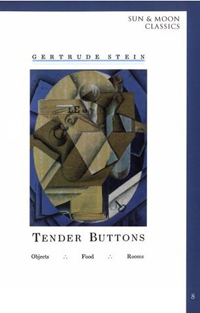
The 1990 Lord's day & Moon Classics edition.
Talking with things in Tender Buttons is also possible because many of Stein'due south objects are breathing or pass through animate states, as in all the food, many of which once had mouths of their own and will finish up in others' mouths. In "Milk," Stein writes, "Climb upward in sight climb in the whole utter needles and a approximate a whole gauge is hanging. Hanging hanging" (Writings, 336). In this clever short poem, every verb tin can convert into a substantive and vice versa, as meaning points in multiple causal directions or "guesses" that are "hanging." It is possible to read the outset of this poem as describing someone or something climbing up into an utter. Utter points to the cow (or some other lactating animate being), every bit well as mouthing words in speech, an utterance that could still very well be the moo-cow's. In Stein's lexicon, cows are likewise metaphors for female sexual acts, and encode a sensuous moment of domestic lesbian life.
Yet even inanimate things speaking need not be far-fetched — modernist objects as various as newspapers, telephones, gramophones, and dolls emit language shaped partially by their textile qualities as things. Here is how Stein describes the globe of "A newspaper," perhaps understood at first as a paper or a notebook: "A courteous occasion makes a newspaper show no such occasion and this makes readiness and eyesight and likeness and a stool" (Writings, 321). The newspaper does non speak from the first-person discipline position, just the newspaper participates as an agile and "courteous" agent while being read, with the words "bear witness" and "occasion" interim as both noun and verb. In this poem, paper ends with "stool," suggesting the deed of reading taking place on a kind of chair or a toilet. If a toilet, perchance this is the first poem ever written as an ode to toilet newspaper. Stein oft emphasizes politeness and courteous behavior, a politesse applicative to persons and things, even in seemingly vulgar situations. Politeness is her default mode of attention to persons and things in a writing that does not decide beforehand who or what can or cannot speak.
The refusal of reference in Stein is also a refusal to make language centered on human usage. Why do this? Modernists experimented with narrative forms that did non necessarily heart on the self or the man species. Daily feel is composed of a variety of breathing and inanimate interactions, many of them not directed to humans or not all the same legible to the recipient. Writing that really reflects daily experience must somehow capture the simultaneous knowledge, limits of cognition, and other forms of knowing that are not directed at the states. If nosotros talk of the perspective of the carafe co-ordinate to the carafe itself, what would we say virtually food, which includes an animate component? Stein's curt poem "Roast potatoes" offers only iii words — "Roast potatoes for" (Writings, 339) — to ask the reader an open up question near what sort of potential purposes make up the composition of food that too make for the limerick of writing. Several of Stein's food poems annals the uncanny world of nutrient equally a curious mixing of lives and interests. "Celery tastes tastes where in curled lashes and lilliputian bits and mostly in remains. A green acre is so selfish and and then pure and so enlivened" (Writings, 340).
This essay has placed on the table several ways of reading Stein's legendary Tender Buttons. Stein's preferred keyword to depict her work is "limerick." A limerick is something material, such equally a folio of sentences on a given topic or a musical score, merely also a term that describes relationships, positions related to other positions. Still life art, or indeed whatsoever set of objects on a table, comprise a composition. Composition applies to things intentionally constructed or unintentionally combined, things bogus as well every bit natural, a landscape painting or the nutritive ingredients in a soil. Stein composed her work out of any ingredients she came upon, from unremarkably used words, everyday objects, personal sensations, and local affairs, to major historical figures and events. These all constituted a continuous surround around her. This surround did not feature Stein every bit the "center" or the code through which everything passes. Instead, she wrote in an aesthetics of surrounds, observing them and living in them. This sense of composition is a near synonym to environs as the context and condition of the life one is living, the "continuous present," as Stein declared.
1. Claire Marie to Gertrude Stein, 18 February 1914, in The Flowers of Friendship: Messages Written to Gertrude Stein, ed. Donald Gallup (New York: Knopf, 1953), 95. The original letters are held at the Yale Collection of American Literature, Beinecke Rare Book and Manuscript Library (cited hereafter as YCAL). Stein's response is not in the Yale athenaeum.
2. Gertrude Stein, Writings 1903–1932 (New York: Library of America, 1998), 815. Cited future as Writings.
iii. Dodge herself harbored deep suspicions of Evans, labeling him a "decadent." Contrivance thought him untrustworthy and recommended non publishing with him in a cable she sent to Stein on 15 March 1914. Stein still had not figured out that Claire Marie was Evans at this indicate. Contrivance sent an expanded letter to Stein on 29 March, disclosing Evans as the person backside the press.
4. Another curiosity to notation is that there is a slip of paper in the Stein athenaeum at Yale that lists several corrections for the book, none of which was ever fabricated or added to subsequent editions. These corrections seem modest, such as changing "Excellent" to "Excel lent" (equally information technology is written in the cahier and in Toklas's typescript), and practise not mention the order of the sections.
5. Here is but one case, a letter sent to Van Vechten on 14 Feb 1914, merely a few days before Evans's first alphabetic character to Stein: "Beloved Beloved: I am now happy. I know you are near by. The loving cup of happiness runs over. I shall write you many sonnets. Donald" (YCAL).
6. Stein, A Primer for the Gradual Understanding of Gertrude Stein, ed. Robert Bartlett Haas (Santa Barbara: Blackness Sparrow Press, 1971), 25.
7. Stein, Operas and Plays (Barrytown, NY: Station Hill, 1998), 105.
8. Kathryn Kent, Making Girls Into Women: American Women'south Writing and the Rise of Lesbian Identity (Durham: Duke University Press, 2003), 164.
9. Marianne DeKoven, A Different Language: Gertrude Stein's Experimental Writing (Madison: University of Wisconsin Press, 1983), 11–12.
x. Stein, A Primer, 18.
eleven. Jayne Walker, The Making of a Modernist: Gertrude Stein from Three Lives to Tender Buttons (Amherst: University of Massachusetts Press, 1984), 136.
12. Craig Dworkin, Reading the Illegible (Evanston, Illinois: Northwestern University Press, 2003), 81.
13. Elizabeth Fifer, Catherine Stimpson, and Lisa Ruddick each connect Stein'due south only fractional legibility to her strategic use of secrecy regarding her sexuality. Come across Fifer, "Guardians and Witnesses: Narrative Technique in Gertrude Stein'south Useful Cognition"; Stimpson, "The Somagrams of Gertrude Stein"; and Ruddick, "A Rosy Amuse: Gertrude Stein and the Repressed Feminine," all in Disquisitional Essays on Gertrude Stein, ed. Michael J. Hoffman (Boston: Grand. G. Hall, 1986).
14. Gertrude Stein, Writings 1932–1946 (New York: Library of America, 1998), 303. In this same discussion, Stein insists heavily on the part of looking in her writing as integrated with talking and listening. "I lived my life with emotion and with things happening but I was creating in my writing merely by looking. I was every bit I say at that fourth dimension reducing every bit far equally information technology was possible for me to reduce them, talking and listening" (303). She concludes that such insights transferred to hither plays and other work, such that "I had also come to have happening at the same looking and listening and talking without any carp most resemblances and remembering" (304).
fifteen. See Bruno Latour, Reassembling the Social: An Introduction to Actor-Network-Theory (New York: Oxford Upwards, 2005).
Source: https://jacket2.org/article/making-tender-buttons

Postar um comentário for "Gertrude Stein Concentrate and Try Again"